Geoscience Birds of a Feather Session – RSECon 2025
Authors: Helen Burns and Isabel Fenton
Following the very successful Weather and Climate Birds of a Feather (BoF) session at RSECon 2024, the Geoscience special interest group (SIG) was formally set up as part of the Society of Research Software Engineers. In May, the first elections were held, and Helen Burns was elected as the Chair, with Isabel Fenton as her deputy.
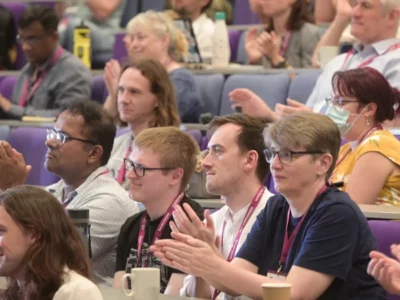
It was agreed by the broader committee that it would be great to run another BoF session at RSECon 2025. This time we went for a mix of keynotes, lightning talks and discussion sessions. It was split over two sessions, and we had over 50 attendees.
We used this opportunity to learn more about the participants via a few Mentimeter questions about attendees’ current domain, main funding source and research background.
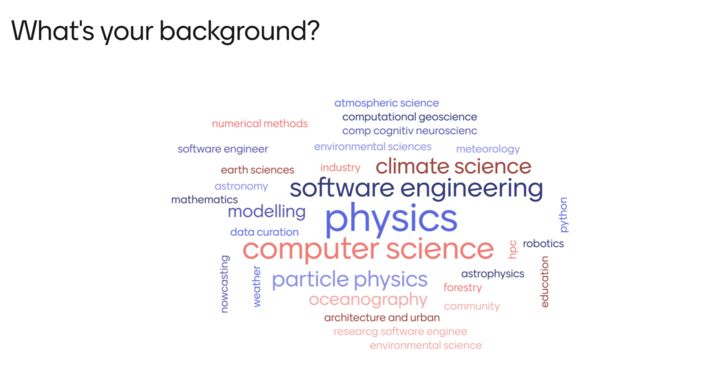
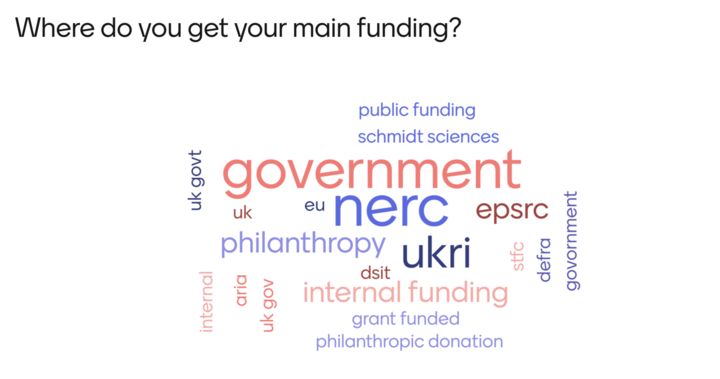
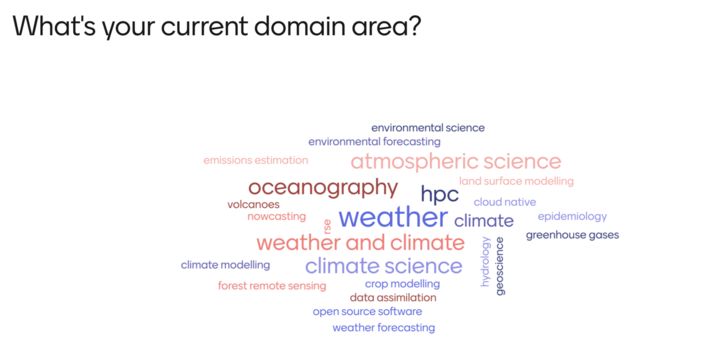
We can take from this that we have a large bias in the community towards weather and climate science. The original proposed name for the SIG actually highlighted this, but given that there’s so much crossover with other parts of the geoscience community, a more inclusive name was chosen, and it was great to see attendance from across the whole community. There was also a mix of employees of government agencies, universities and independent research organisations highlighted in the funding source responses. The attendees had a diverse range of backgrounds, suggesting domain knowledge helps with accessing these roles, but is not always essential.
Keynote speakers
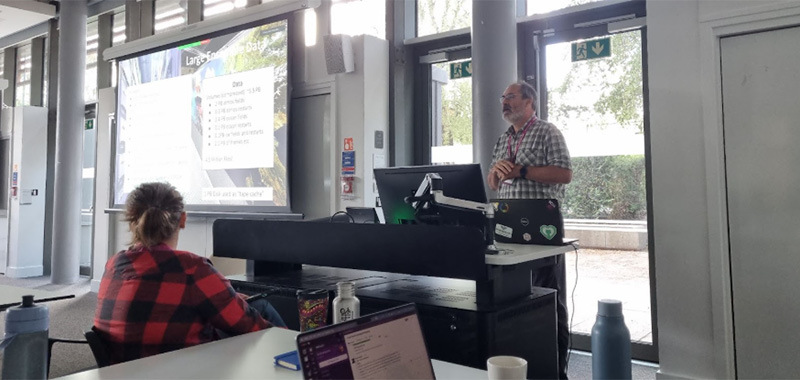
During the session, we hosted two keynote speakers. The first of these was Brian Lawrence from NCAS, who presented an overview of the various ways in which RSE activities support the research they conduct. This varied from computational and model support for NCAS Researchers, through development and maintenance of popular domain toolkits like cf-python, to infrastructure for physical experiments and observations.
The second keynote speaker was Andrea Sharpe, who came from a different angle as part of the Natural Environment Research Council (NERC), one of the participants’ main funders. She presented on Digital Research Infrastructure and explained how NERC sees this linking to the priorities for environmental research over the next 10 years.
Lightning talks
The lightning talks showed the range of activities and work done in the Geoscience RSE Community. The speakers and topics were:
- Tobias Ferreira – Zarr in the Browser: Fast and Flexible for Big Geo Data
- Dimitrios Theodorakis – Climate Music
- Matt Dalle Piagge – (Attempting to) UniFHy hydrological modelling
- Joe Wallwork – Accelerating UKCA by predicting timesteps with FTorch
- Esther Turner – A Data Science Platform Demo
- Henry Wright – Iris: A powerful, format-agnostic, and community-driven Python package for analysing and visualising Earth science data
All the slides for these presentations can be found on Zenodo, and a recording can be found on YouTube. The talks help provide lots of material for a group discussion.
Breakouts
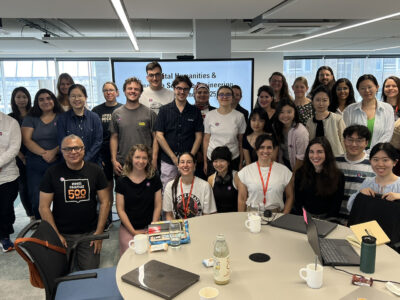
We then had 20 minutes to discuss the following questions:
- How do you measure success in your team / individually?
- Career progression pathways that exist or that you would like to see
- Any training gaps for domain knowledge? And ways to fix those?
Measuring success had a lot of variability with no universal metrics to use. Academic-focused RSEs could use paper output to show success, whereas government agency workers had clearer deliverables. Zenodo records and GitHub repositories were used with the caveat that they weren’t always understood as a metric to funders. Career progression varied widely between employers, with some employers offering little to no career progression, others with clear pathways retaining technical roles, whilst other organisations’ career progression only led to management roles. As for training gaps, this again differed between different employers, but a general lack of scientific training was highlighted. For technical geoscience-focused training, it was suggested that the SIG could offer a way of highlighting what is more widely available. An overview of the discussion points can be found on our website.
Going forward
We wrapped up the session with a discussion of what people would like to get from the SIG going forward. We are intending to apply for another Birds of a Feather session at RSECon 2026. There was a definite appetite for more events, either in-person or virtual. So we will aim to run a virtual session of talks, to give more people the opportunity to present their research. We also talked about doing some more informal sessions in the format of a “bring your own problem” discussion forum. Both options would provide good opportunities for knowledge sharing among the community.
We also discussed how we can expand our website to make it a central point for resources. We will link to relevant open seminar series and blog posts. There was an appetite for creating a list of useful resources which people could contribute to. This could take the form of case studies, short intros, or just links to relevant software. We discussed the challenge of keeping this material up-to-date, maybe using RSECon each year as a place to review it.
Following RSECon25, this spring, we are putting on a virtual seminar. Keep your eyes peeled for a call for abstracts in March 2026 and for more details on our website.